 THE CAPTAIN'S METHOD™
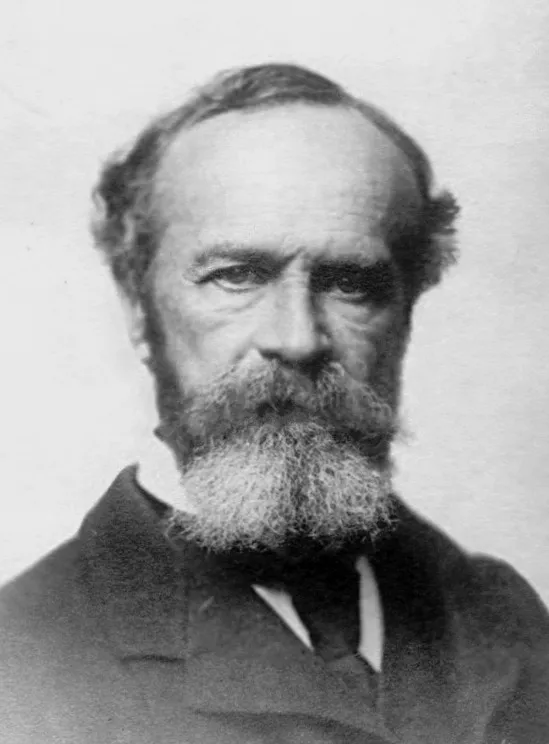
William James
Where this shows up in the Captain’s Method
James sits at the root of the Focus section's synthesis line, I choose my stimuli with my focus, since he argued more than a century ago that experience is what we agree to attend to. His habit rules are the science under our delivery rule of muscle memory first and theory second. Pragmatism supplies the logic of proof, where members show evidence for each Return Map step, and of the Measurement chapter, where a belief about the work counts when it changes a number someone can see.
- Focus
James wrote that experience is what we agree to attend to, the founding claim of Focus.
- Capacity
His chapter on habit shows how repeated action wears paths into the nervous system, which is how skill becomes automatic.
- Personality
Pragmatism treats belief as something tested in action, which fits a stance that learns by doing.
James was born in New York City in 1842, the older brother of the novelist Henry James, and earned a medical degree at Harvard in 1869 that he never used to practice. He began teaching at Harvard in 1873 and by 1875 had set up one of the first psychology laboratories in the United States. In 1878 he agreed to write a psychology textbook for the publisher Henry Holt; it took twelve years and came out in 1890 as two volumes of about twelve hundred pages. He later turned to philosophy and made pragmatism, first framed by Charles Sanders Peirce, into a public movement.