Field Note · Personality — Master Article
The Adventure Personality.
The Engagement Side of Leadership

Out of the night that covers me, black as the pit from pole to pole, I thank whatever gods may be for my unconquerable soul. In the fell clutch of circumstance I have not winced nor cried aloud. Under the bludgeonings of chance my head is bloody, but unbowed. — William Ernest Henley, Invictus
In 1875, a young English poet named William Ernest Henley lay in a hospital bed facing a future that seemed to be shrinking by the day. Tubercular arthritis had already cost him one leg, and physicians expected the disease to claim the other. Pain was a constant companion, and the future offered uncertainty rather than promise. Yet it was from this setting that Henley wrote one of the most enduring declarations of human agency in the English language.
What makes the poem's famous ending remarkable is not its optimism; there is almost no optimism in it. Henley never claims that circumstances will improve. He does not suggest that suffering is temporary. Instead, he makes a much narrower and more radical claim: human beings may lose opportunities, possessions, status, freedom, certainty, and even health, but they do not have to lose authorship.
Nearly a century later, another man would discover the power of that distinction. Confined to a prison cell on Robben Island, Nelson Mandela spent decades under conditions specifically designed to dismantle identity, agency, and hope. Henley's words became an internal anchor. Mandela could not control his confinement, could not negotiate away circumstance, and could not will prison walls into disappearance. But he could refuse to let the prison become the governing authority of his mind.
The Missing Variable
For more than a century, psychologists, educators, and organizational leaders have searched for the qualities that explain why some people thrive under pressure while others collapse beneath it. The usual suspects are familiar: intelligence, talent, personality, resources, and opportunity. Each matters. None is sufficient.
The missing variable appears to be neither ability nor circumstance. It is agency — the capacity to remain an active participant in reality rather than a passive recipient of it. When confronted by uncertainty, one person asks, "Why is this happening to me?" while another asks, "Given that this is happening, how shall I engage it?" The external reality may be identical, but the internal orientation is entirely different. Over months, years, and decades, it becomes destiny.
The Captain and the Passenger
Most people understand the metaphor of the captain intuitively. A passenger experiences the voyage, while a captain accepts responsibility for navigation. The critical insight is that a captain does not control the sea — no captain commands the weather, abolishes storms, or negotiates with gravity. A captain operates under constraint. Yet despite lacking control of conditions, the captain accepts ownership of response.
This is the foundational distinction of the Captain's Method: the goal is not control; the goal is authorship. Control is largely external, while authorship is internal. Control depends upon circumstance, but authorship persists despite circumstance. When Henley declared himself captain of his soul, he was not claiming power over reality; he was claiming responsibility for engagement with reality.
What Psychology Reveals
The remarkable thing about Henley's stance is that modern psychology increasingly suggests it is not mystical. It is understandable, and more importantly, it is trainable. The foundations begin with integrity: when people repeatedly betray what they know to be true, enormous psychological energy becomes consumed by justification, defensiveness, and distortion. Perception ceases to serve reality and begins serving ego protection, and agency weakens.
At the same time, exploration requires security. Attachment research repeatedly demonstrates that human beings venture furthest from a reliable base. Courage is not normally produced by the absence of security, but by the presence of sufficient security to tolerate uncertainty. Stress researchers have long observed that individuals respond differently depending on whether a demand is interpreted as a threat or a challenge — threat narrows perception, whereas challenge expands engagement.
Repeated engagement produces what Mihaly Csikszentmihalyi described as the autotelic personality: individuals who discover intrinsic satisfaction in growth, learning, mastery, and complexity itself. Taken together, these findings point toward a single conclusion: the people we call resilient, courageous, adaptable, and adventurous often share a deeper commonality — they have learned to participate in reality rather than wage war against its existence.
The Sources of Navigational Capability
If agency is the capacity to remain a participant in reality, then navigational capability is the capacity to do so well. The Captain's Method proposes that this capability emerges from the convergence of six qualities:
Adventure + Truth + Equanimity + Mastery + Recognition + Humility = Navigational Capability
Adventure provides the willingness to engage reality rather than withdraw from it. Truth protects against the distortions of self-deception. Equanimity prevents emotion from becoming the master of perception. Mastery develops competence capable of transforming intention into action. Recognition allows us to perceive other people as they are rather than as instruments of our own agendas. Humility preserves the capacity to revise our understanding when reality proves us wrong.
This is navigational capability. Not control of the environment. Not immunity from suffering. Not certainty about the future. Simply the capacity to continue steering.
The Unconquered Orientation
Henley's genius was not that he believed he could command the sea. Mandela's greatness was not that he escaped the storm. Both understood the same truth: the human spirit does not become unconquerable by gaining control of reality. It becomes unconquerable by refusing to surrender authorship.
Henley expressed it from a hospital bed. Mandela embodied it from a prison cell. The Captain's Method seeks to cultivate it as a way of life. For what remains unconquered is not the world. What remains unconquered is the willingness to take the helm.
- Aristotle, Nicomachean Ethics
- Epictetus, Enchiridion
- Marcus Aurelius, Meditations (trans. Robin Hard, Oxford World’s Classics, 2011)
- Seneca, Letters from a Stoic (Penguin, 2004)
- William James, “The Energies of Men,” Science, vol. 25, no. 635 (1907)
- Mihaly Csikszentmihalyi, Flow: The Psychology of Optimal Experience (Harper Perennial, 2008)
- Nakamura & Csikszentmihalyi, “The Concept of Flow,” Handbook of Positive Psychology (2002)
- Daniel Kahneman, Thinking, Fast and Slow (Farrar, Straus and Giroux, 2011)
- Michael Polanyi, The Tacit Dimension (University of Chicago Press, 2009)
- Blascovich & Tomaka, “The Biopsychosocial Model of Challenge and Threat,” Advances in Experimental Social Psychology, vol. 28 (1996)
- Argyris & Schön, Organizational Learning: A Theory of Action Perspective (Addison-Wesley, 1978)
- C. Terry Warner, Bonds That Make Us Free (Shadow Mountain, 2001)
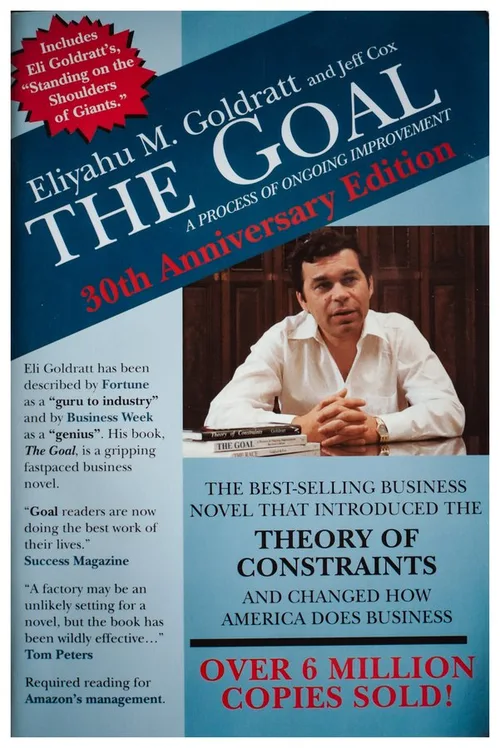
- Eliyahu M. Goldratt, The Goal: A Process of Ongoing Improvement (North River Press, 2014)
- Amy C. Edmondson, The Fearless Organization (Wiley, 2018)
- Donella H. Meadows, Thinking in Systems: A Primer (Chelsea Green Publishing, 2008)
- John Bowlby, Attachment and Loss; A Secure Base (Basic Books, 1988)
- Brooke C. Feeney, “The Dependency Paradox in Close Relationships,” Journal of Personality and Social Psychology, vol. 86, no. 2 (2004)
- William Ernest Henley, Invictus (1875)
- Nelson Mandela, Long Walk to Freedom (Little, Brown and Company, 1994)